Writing practice
Original evidence prompts, starting with short September catch-up work. Type an answer and turn it in for teacher review, or print the sheet and write by hand.
Practice 1 of 9 · Structure and Function · Foundational measurement skill
Explain a water-density result
Measuring water, original class model
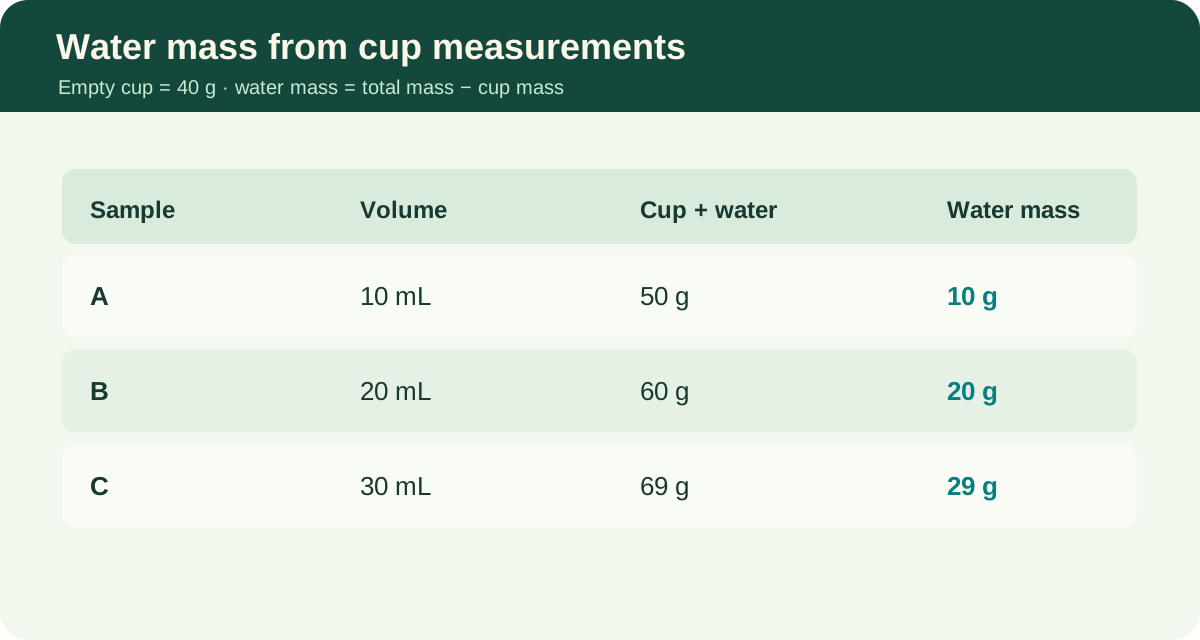
A student places an empty cup on a balance. Then the student adds water. Mass is measured in grams (g). Volume is measured in milliliters (mL).
| Trial | Empty cup | Water volume | Cup plus water |
|---|---|---|---|
| A | 40 g | 10 mL | 50 g |
| B | 40 g | 20 mL | 60 g |
| C | 40 g | 30 mL | 69 g |
Density = mass of water ÷ volume of water. In this model, the expected density is about 1 g/mL.
Use the cup and water measurements in trial B to find the mass of only the water and its density. Then explain why the empty cup mass must be removed.
Sentence starter: The water mass was ___ g because ___. Its density was ___ g/mL because ___. The cup mass must be removed because ___.
Practice 2 of 9 · Structure and Function · Foundational evidence skill
Make a claim from indicator tests
Matching indicator evidence, original model
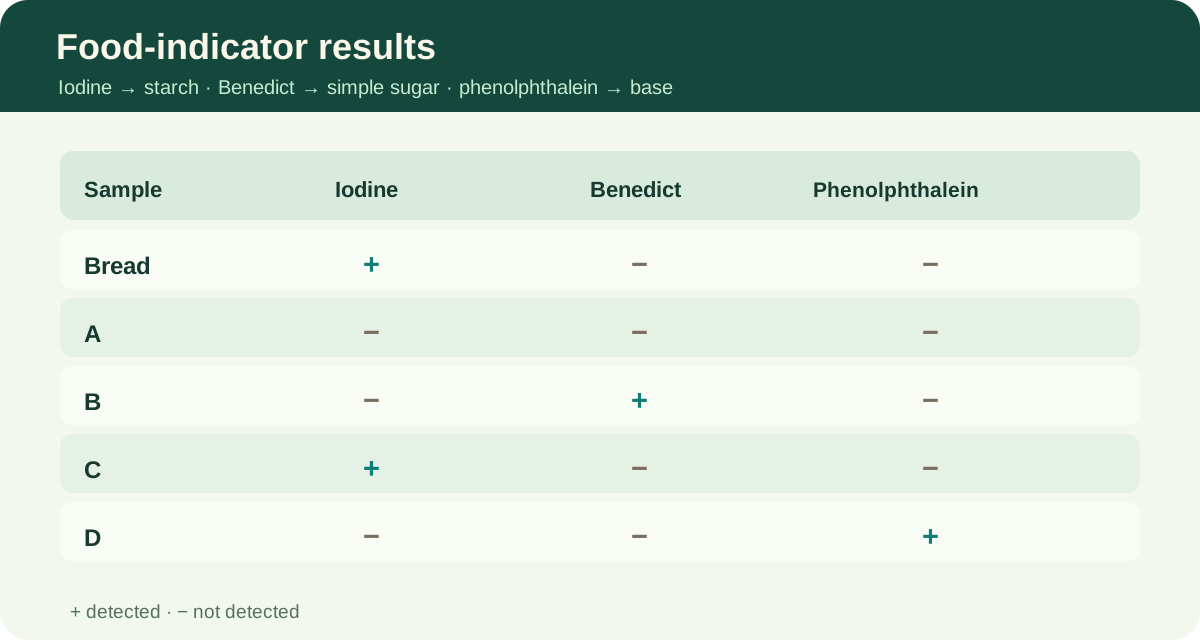
In this model, iodine turns dark for starch. A heated Benedict test changes color for simple sugar. Phenolphthalein turns pink for a basic liquid. A plus sign means a positive test.
| Sample | Iodine | Benedict | Phenolphthalein |
|---|---|---|---|
| Bread | + | − | − |
| Liquid A | − | − | − |
| Liquid B | − | + | − |
| Liquid C | + | − | − |
| Liquid D | − | − | + |
Compare all three results. A matching pattern suggests a shared tested substance; it does not prove the samples are identical.
Which mystery liquid has the same tested pattern as bread? Use all three indicator results as evidence. State one limit of this conclusion.
Sentence starter: Liquid ___ matches bread because both are ___ on iodine, ___ on Benedict, and ___ on phenolphthalein. This does not prove ___.
Practice 3 of 9 · Structure and Function · Foundational cell skill
Explain water movement in cells
Cell and water model, original data
Two groups of the same kind of plant cell begin at 12 µm wide. After 15 minutes:
| Liquid | Width |
|---|---|
| Fresh water | 14 µm |
| Concentrated salt water | 9 µm |
surrounding liquid ⇄ cell membrane ⇄ cell interior
Use both cell-width results. Explain which way water likely moved in each group, and name the cell part it crossed.
Sentence starter: In fresh water, cells changed from ___ to ___, so water likely ___. In salt water, ___. Water crossed the ___.
Practice 4 of 9 · Foundations and scientific sense-making · HS-ETS1-1
Choose a next design test
Rain barrel design challenge
A school wants to capture rain for its garden. Its roof sends about 50 liters into a barrel during a typical storm. The team can spend $70. The barrel must hold at least 40 liters without leaking. Prototype A holds 42 liters and costs $58. Prototype B holds 60 liters and costs $82. In one trial, A leaked 2 liters and B did not leak.
The team wants a barrel that meets every stated requirement. Explain which prototype you would revise first. Use two measurements or requirements from the situation, then name a test for the revised design.
Sentence starter: I would revise ___ because the evidence shows ___. I would test ___ to find out whether ___.
Practice 5 of 9 · Structure and Function · HS-LS1-3
Explain a feedback response
A greenhouse leaf response
Bean plants in a greenhouse receive the same water and soil. On a mild day, leaf pores are open, water leaves the leaves, and roots replace it. On a hot, dry day, the leaf pores become narrower and measured water loss falls. A line of plants with a changed gene makes fewer working pore-control proteins and loses more water on the hot day.
Use the hot-day observations to explain how the plant responds to dry air and how that response can help maintain its internal water supply.
Sentence starter: When the air became ___, the leaf pores ___. This could help the plant because ___.
Practice 6 of 9 · Matter and Energy, including Earth systems · HS-ESS2-6
Account for carbon
Carbon in a classroom terrarium
A sealed classroom terrarium contains plants, soil microbes, and air. At noon, a sensor reads 500 units of carbon dioxide in the air. During six hours of light, plants take 90 units of carbon from the air into new sugar, while respiration by plants and microbes returns 50 units to the air. In the dark, photosynthesis stops but respiration continues. The terrarium stays sealed.
Calculate the air carbon dioxide reading after the six lighted hours. Explain where carbon removed from the air went and why it did not vanish from the sealed terrarium.
Sentence starter: The air reading is ___ because ___. Carbon removed from the air ___.
Practice 7 of 9 · Inheritance and Variation · HS-LS3-3
Separate genes and environment
Garden pea leaf patterns
Two pea plants each carry one copy of a spotted-leaf gene form S and one plain-leaf form s. In this simplified model, S is dominant. Each parent makes gametes carrying S or s. Four equally likely combinations are SS, Ss, sS, and ss. A separate greenhouse trial finds that low light can make some spotted leaves look less distinct without changing the DNA form.
Explain why offspring from the same two plants can inherit different leaf-pattern combinations. Then explain why a faintly spotted leaf in low light does not prove that the plant has the ss combination.
Sentence starter: Different offspring can inherit ___ because ___. A faint pattern does not prove ss because ___.
Practice 8 of 9 · Natural Selection and Evolution · HS-LS4-4
Explain a population shift
Seed beetles after a dry season
A beetle species has inherited long and short mouthpart variants. Both variants feed on seeds. After several dry years, plants with thicker seed coats become more common. In a sample of 100 beetles before the dry years, 25 have long mouthparts. In a sample of 100 several generations later, 68 have long mouthparts. Long-mouthed beetles can open more of the thick-coated seeds and produce more surviving offspring in this habitat.
Use the beetle counts and seed-coat change to explain why long mouthparts became more common over several generations. Describe a change in the population, not a choice made by an individual beetle.
Sentence starter: The share with long mouthparts changed from ___ to ___. Because this trait is inherited, beetles with ___ were more likely to ___.
Practice 9 of 9 · Interdependent Relationships in Ecosystems · HS-LS2-7
Evaluate a mowing claim
A vacant-lot meadow project
A class compares two equal-size city lots using the same sampling method. Lot A has 5 flowering plant species and 30 counted flowering plants. Lot B has 9 species and 30 plants. Over one hour, students count 12 pollinator visits in A and 27 in B. A proposed mowing schedule would remove all flowers during the pollinator breeding season. A second plan leaves half the lot flowering and costs $200 more.
A council member says mowing all the flowers during breeding season will not affect pollinators because both lots have 30 plants. Evaluate this claim using the available evidence. Identify one measurement needed after mowing.
Sentence starter: The claim is not established because ___. After mowing, I would measure ___ and compare it with ___.